
Introduction to Sindh Farmers Subsidy Issue
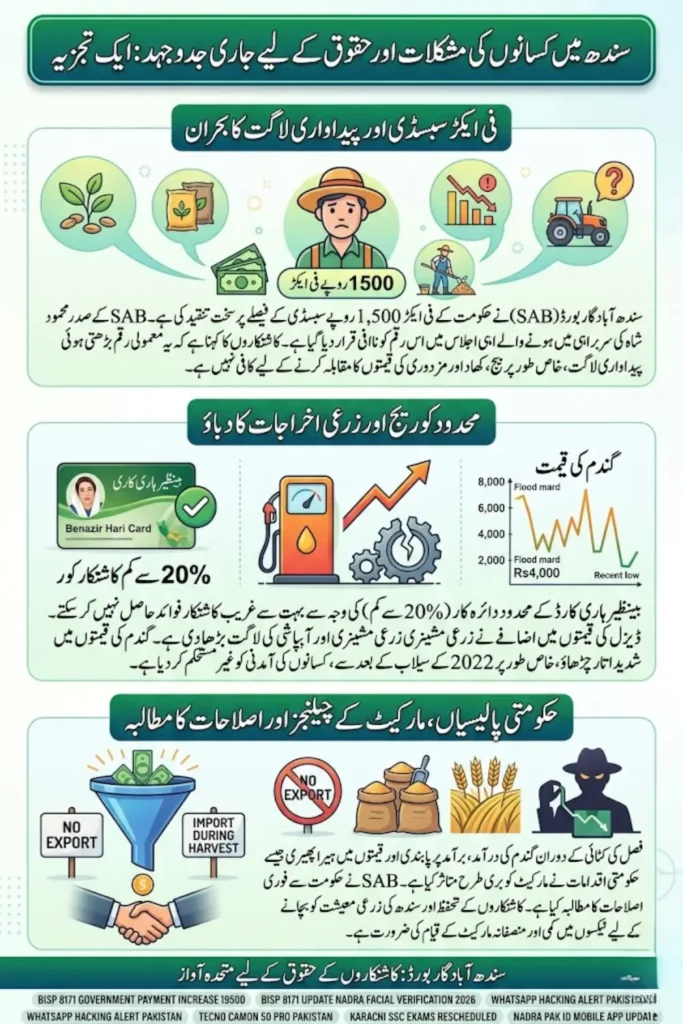
The Sindh farmers subsidy issue has gained attention after strong criticism from the Sindh Abadgar Board, a key farmers’ lobbying group in the province. The board has raised concerns over the government’s decision to provide a subsidy of Rs1,500 per acre, calling it insufficient to meet the financial needs of small farmers. Agriculture plays a vital role in Sindh’s economy, and any imbalance in support can directly affect millions of livelihoods.
Farmers across the province are already facing economic pressure due to rising costs and unstable crop prices. The current subsidy, according to stakeholders, does not match the increasing expenses required for cultivation and farm management.
- Subsidy set at Rs1,500 per acre
- Considered inadequate by farmers
- Agriculture is a key economic sector in Sindh
You Can Also Read: BISP 8171 Government Payment Increase 19500 April 2026: Eligibility, PMT Score
SAB Meeting and Key Discussions
The issue was formally discussed during a Sindh Abadgar Board meeting held in Hyderabad. The meeting was chaired by President Mahmood Nawaz Shah and attended by several farmers and agricultural experts. Participants shared their concerns regarding the financial challenges faced by growers across the province.
The discussion focused on the need for immediate policy changes and stronger government support. Farmers highlighted that without proper assistance, the agricultural sector could face further decline.
- Meeting held in Hyderabad
- Chaired by SAB President
- Focus on farmer financial challenges
The gathering served as a platform for collective voices demanding reforms and better planning in the agriculture sector.
You Can Also Read: BISP 8171 Update NADRA Facial Verification 2026: Complete Process for Payment Collection
Concerns Over Insufficient Subsidy
Farmers strongly believe that the current subsidy does not reflect the actual cost of cultivation. With rising input prices, including seeds, fertilizers, and labor, the Rs1,500 per acre support is seen as too small to provide meaningful relief.
The subsidy amount falls short of addressing real financial burdens, leaving small farmers vulnerable to losses. Many participants emphasized that the gap between costs and support continues to widen.
- Rising cost of inputs not covered
- Small farmers most affected
- Demand for increased subsidy
This situation highlights the need for a more realistic approach in calculating financial assistance for farmers.
Benazir Hari Card and Its Limitations
The Sindh farmers subsidy issue also includes discussion around the Benazir Hari Card, which was acknowledged as a positive initiative by the board. However, its current reach remains limited, covering less than 20 percent of small farmers in the province.
Despite its potential, the program has not yet achieved widespread impact. Many farmers are still unable to access its benefits due to limited coverage and implementation challenges.
- Covers less than 20 percent of farmers
- Recognized as a positive step
- Needs expansion for wider reach
| Program | Coverage | Impact |
|---|---|---|
| Benazir Hari Card | Limited | Partial relief |
| Subsidy Scheme | Province-wide | Insufficient support |
Expanding this initiative could help improve financial inclusion and provide better support to small growers.
Impact of Rising Diesel Prices
The increase in diesel prices has added another layer of difficulty for farmers. Fuel is essential for running agricultural machinery, irrigation systems, and transportation, making it a critical component of farming operations.
With higher fuel costs, farmers are now facing increased expenses in every stage of cultivation. This situation is expected to further reduce profit margins and increase financial stress.
- Diesel price hike affects machinery use
- Transportation costs have increased
- Overall cultivation cost is rising
The growing dependency on fuel makes this issue particularly challenging for small-scale farmers.
You Can Also Read: WhatsApp Hacking Alert Pakistan – CERT Warning, Latest Scams, Security Risks
Wheat Prices and Policy Concerns
Wheat prices have been a major concern for farmers in recent years. After the 2022 floods, the government set the wheat price at Rs4,000 per 40kg to support farmers. However, by early 2024, prices dropped significantly to Rs2,200 per 40kg.
Although procurement resumed later with a support price of Rs3,500 per 40kg, market rates remain lower at around Rs3,200. This difference has created uncertainty and dissatisfaction among farmers.
- Price dropped from Rs4,000 to Rs2,200
- Current support price is Rs3,500
- Market rate is around Rs3,200
| Year/Condition | Wheat Price (per 40kg) |
|---|---|
| Post-2022 floods | Rs4,000 |
| Early 2024 | Rs2,200 |
| Current support price | Rs3,500 |
| Market price | Rs3,200 |
These fluctuations highlight the instability in agricultural markets and the need for better price management policies.
Government Policies and Market Challenges
Farmers have also raised concerns about government policies that affect market conditions. The timing of wheat imports during harvest season has been criticized, as it reduces demand for locally produced crops.
Restrictions on exports and issues like stockpiling and price manipulation have further complicated the situation. These factors create an uneven market environment that disadvantages farmers.
- Imports during harvest affect prices
- Export restrictions limit opportunities
- Stockpiling leads to market imbalance
Addressing these challenges requires coordinated policy measures and stricter market regulation.
You Can Also Read:
Call for Urgent Reforms in Agriculture
The Sindh Abadgar Board has called for urgent reforms to address the ongoing crisis. According to estimates, rising fuel prices and other factors could increase cultivation costs by up to Rs12,000 per acre.
Farmers have urged the government to take practical steps such as reducing taxes on agricultural inputs and ensuring fair market practices. These reforms are essential to protect the agricultural sector from further decline.
- Cultivation costs may rise significantly
- Need to reduce taxes and levies
- Demand for fair market practices
Immediate action can help stabilize the sector and restore confidence among farmers.
You Can Also Read: TECNO CAMON 50 Pro Pakistan – Price, Specifications, SuperZoom FlashSnap
Participation of Agricultural Leaders
The meeting was attended by several prominent agricultural leaders, including Dr Bashir Nizamani, Syed Nadeem Shah, Imran Bozdar, Taha Memon, and Masroor Soomro. Their participation added weight to the discussion and highlighted the seriousness of the issue.
These leaders collectively emphasized the importance of strong policy support and long-term planning. They stressed that protecting Sindh’s agro-economy should be a top priority.
- Presence of key agricultural figures
- Unified demand for better support
- Focus on long-term sustainability
Their involvement reflects a shared concern for the future of agriculture in the province.
You Can Also Read: Karachi SSC Exams Rescheduled to April 10 Due to Digital System Transition
Conclusion
The Sindh farmers subsidy issue highlights the growing challenges faced by the agricultural sector. From insufficient subsidies to rising fuel costs and unstable crop prices, farmers are dealing with multiple pressures at once.
Addressing these issues requires timely and effective government intervention. With proper reforms and increased support, the agricultural sector in Sindh can recover and continue to play its vital role in the economy.
FAQs
What is the Sindh farmers subsidy issue?
It refers to farmers’ concerns over the Rs1,500 per acre subsidy being too low. They believe it does not cover rising cultivation costs.
Why are farmers criticizing the subsidy amount?
Farmers say the amount is insufficient compared to increasing input and fuel costs. It fails to provide meaningful financial relief.
What is the Benazir Hari Card program?
It is a support initiative for farmers in Sindh. However, it currently covers less than 20 percent of small growers.
How have wheat prices affected farmers?
Wheat prices have fluctuated significantly, reducing farmers’ income. Market rates remain lower than government support prices.
You Can Also Read: NADRA Pak ID Mobile App Update Introduces Easier Visa Applications